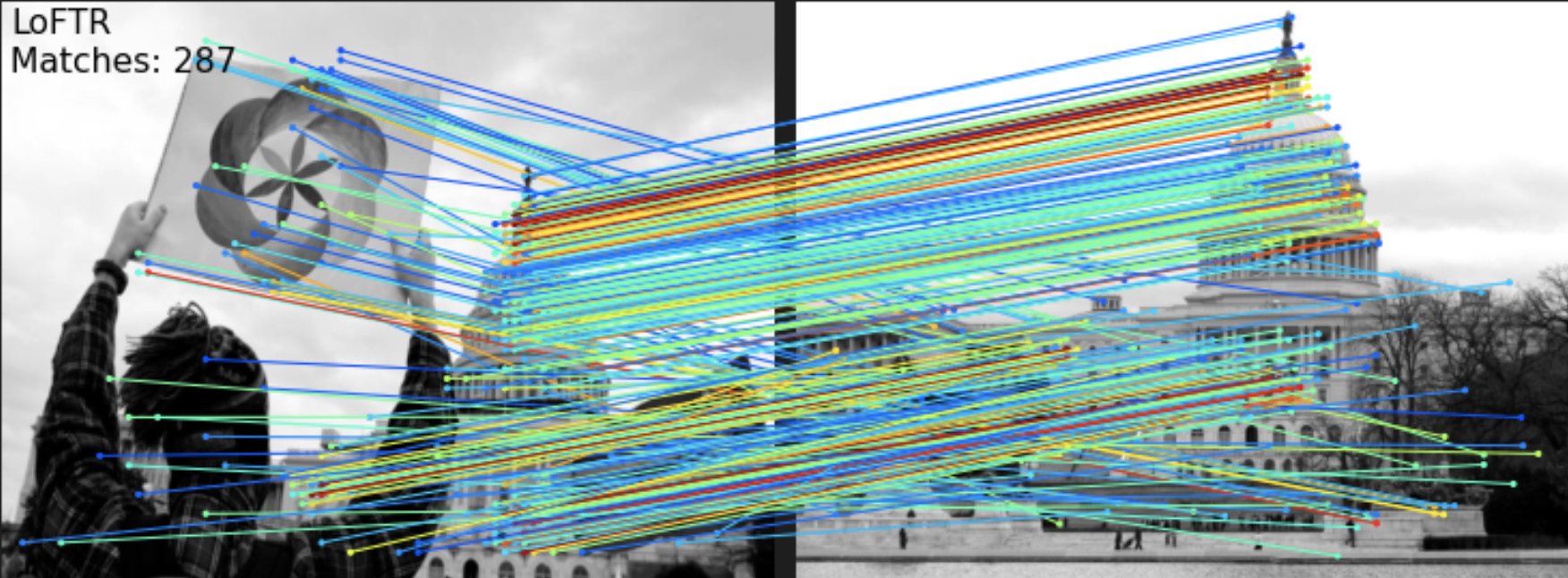
LoFTR extracts high-quality semi-dense matches even in indistinct regions — low texture, motion blur, repetitive patterns. We re-implemented it in TensorFlow to widen its reach beyond the original PyTorch release.
Abstract
This project proposed a re-implementation of the LoFTR algorithm, the state-of-the-art method for detecting feature matches between images using deep neural networks. Originally published in PyTorch, a common research library, this project re-implements the model’s complex architecture in TensorFlow, a framework more commonly used in industry. Time constraints meant a full training run could not be completed, but the outcomes show the implementation functions as expected — and with a training sample more closely aligned to the original paper, the results would align more closely too.
Presentation
Acknowledgements
We would like to specially thank the teaching team for Robot Perception Fall 2022, without whom this project could not have been completed. We would also like to thank NYU for graciously allowing us to use the HPC cluster to train our models.